
Study and empirical prior work
Existing 3D and image data have been used in several analyses addressing facial ageing, feature ratings, and observer variability.
For the study of age-related facial features, eight observers rated 32 predefined features on standardised image plates of 18 adults aged 27 to 84 years. Repeat ratings were available for eight targets.
This allows three levels to be examined separately: association of a feature rating with chronological age, agreement between different observers, and stability when the same observer repeats the rating.
Person-identifying image data and raw values are not made publicly available.
Visible cue areas
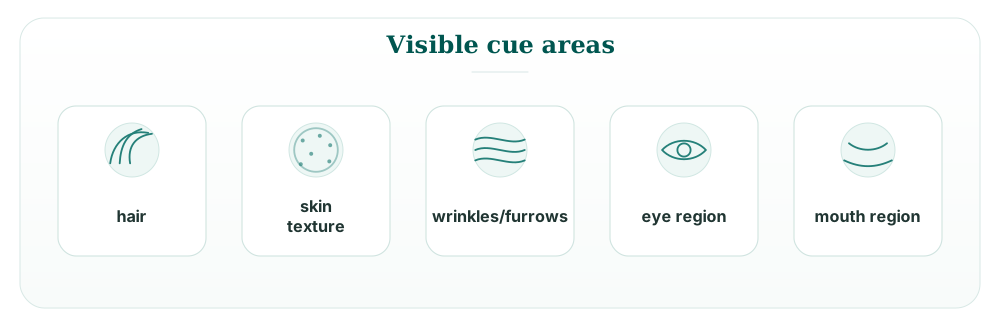
The 32 rating variables covered several areas in which age can become visible in the face. The overview shows these areas without evaluating or ranking individual features.
Cues as visible information
The prior work treated ageing cues as visible information that has to be recognisable, comparable, and rateable by observers. Lines and grooves, gain and loss describe different directions of visible change.
Lines and grooves
Lines, wrinkles and grooves describe visible surface and relief structures. They become informative only when their course, expression and comparability are visible in the image.
Gain and loss
Gain refers to visible findings that may appear or become more pronounced with age. Loss means that existing structures become weaker, thinner, or lose contour.
Observer judgement
Two questions should be distinguished analytically: whether a cue is rated repeatedly and similarly by observers, and whether its rating is associated with the age judgement.
Age relation of judgements and cue groups
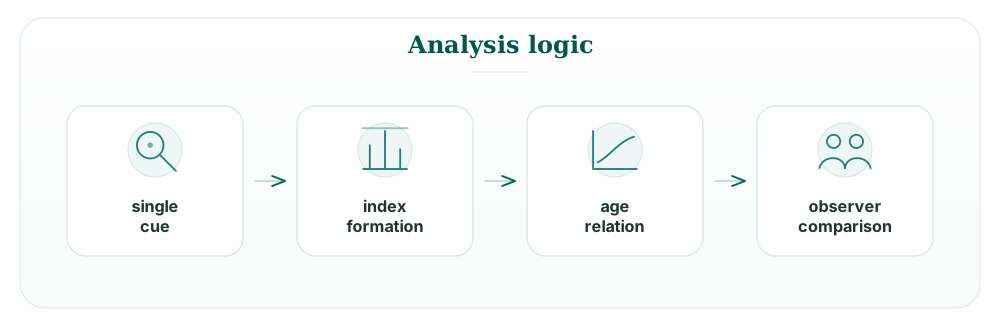
Age judgements may be associated with several cue groups; no single visible cue necessarily accounts for them. Single cues were first rated separately. For analysis, related cues were combined into summary measures. These included wrinkles, grooves, and lines, age signs that may appear or become more pronounced, and features where existing structures become weaker, thinner, or lose contour. This made it possible to examine how cue groups relate to age judgements, chronological age, observer differences, and retest effects.
Analysis logic
Age association and reliability
Analysis of the existing dataset shows why age association and reliability should not be treated as equivalent. Across the 31 regularly analysable markers, both association with chronological age and agreement between observers vary substantially.
Ocular opacity provides a concrete example: the aggregated feature rating shows a very high age association in the present material (Spearman ρ = 0.942), whereas interobserver reliability is markedly lower (ICC = 0.462). Within-observer retest stability is higher (ICC = 0.824).
The example illustrates a central methodological distinction: a feature may be strongly associated with age without being rated equally reliably by different observers. Conversely, high reproducibility does not demonstrate diagnostic or identification value.
Repeatability and observer variability
Across the 31 regular markers, the mean interobserver ICC was 0.578. Marker-specific retest ICCs averaged 0.794; for 30 of 31 markers, within-observer repeatability exceeded agreement between different observers.
These findings concern reproducibility of morphologically defined feature ratings. They are neither a validation of individual age diagnosis nor a measure of the evidential value of a feature in person identification.