Abstract
FaceMindLab brings together work and research interests on visual judgment formation for faces and person cues. The focus is on perception, information use, cue weighting, confidence, uncertainty, observer variability, and decision-making.
The starting point is the assessment of persons from images. Such judgments do not arise in isolation. Image quality, perspective, visible cue expression, comparison material, prior information, and subjective confidence influence how observers arrive at a judgment.
What interests me is this transition: What is visible in the image? What is actually perceived from it? Which cues are weighted? And when does an impression become a supported or limited judgment?
The central focus is visual information use: Which visible cues are used, how are they weighted, and when do judgments become confident, uncertain, or variable?
Material / Methods: 3D stimulus material · standardized views · visual judgments · confidence · observer variability · calibration
Conceptual frame
Visual person judgments can be understood as an interaction of three levels. First, there is visible information: facial contours, aging signs, soft-tissue structures, hair and skin cues, image quality, view, and perspective. Second, there is the use of this information: attention, selection, comparison, and weighting. Third, there is a decision: an age judgment, a similarity judgment, a same/different judgment, or deliberate restraint. Perception is not treated as a passive copy of the image, but as a selective and constructive process: attention restricts available information to task-relevant cues.
These levels do not collapse into one another. A structure may be visible without being reliably assessable. A cue may appear salient without carrying the judgment. Subjective confidence may be appropriate, but it may also arise from expectation or apparent plausibility.
I therefore distinguish between image information and judgment information. Image quality, perspective, illumination, and expression determine which cues are available. Attention, comparison standard, and decision criterion determine how these cues are used. Only from this interaction does a judgment about age, similarity, difference, or assessability emerge.
Research logic
The research fields describe recurring questions across visual person assessment: visual age perception, facial comparison, similarity decisions, image information, confidence, and the handling of ambiguity.
A further focus is the distinction between impression and supported judgment: Which assessments are shared between observers, which remain dependent on context or individual observer, and where does overinterpretation begin?
| Focus | Guiding question |
|---|---|
| Visual information use | Which facial and person cues are perceived, attended to, and weighted? |
| Visual age perception | How are visible aging signs integrated into age judgments? |
| Confidence and uncertainty | When do observers experience a judgment as certain, uncertain, or ambiguous? |
| Observer variability | Why do people differ in visual judgments about the same stimuli? |
| Judgment quality | How stable, calibrated, and shareable across observers are visual judgments? |
| Image information and context | How do perspective, quality, prior information, and comparison conditions influence the decision? |
Process model
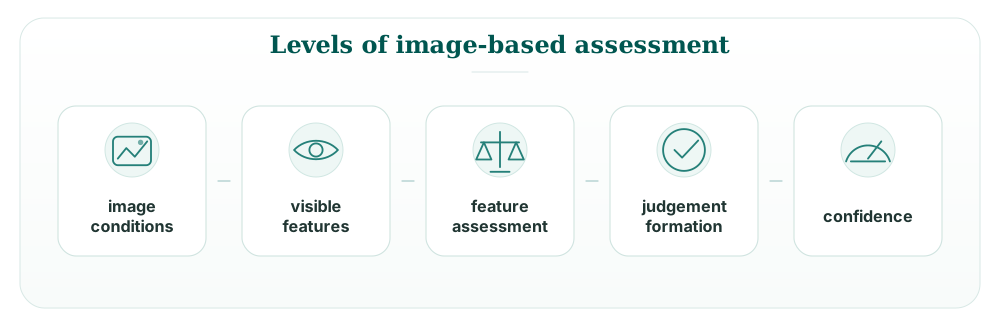
Visual person assessment is treated here as a process. A visible cue must first be perceived. It is then related to other information, weighted, and translated into a judgment. Only then does the question arise of how confident that judgment feels.
The final step is central. A judgment is not supported merely because it appears plausible. It matters whether it is stable, transparent, calibrated, and justifiable under the given image conditions.
Stimulus material and morphological prior work
Stimulus material
A central methodological resource is a stimulus pool of three-dimensionally captured faces and associated image data. The material comprises 208 persons aged 9 to 85 years and allows standardized views to be derived for observer studies.
This is not merely an image collection, but a controllable material system. Views, perspectives, and visible cue information can be varied systematically. This makes the pool suitable for questions of visual age perception, facial comparison, confidence, and observer variability.
Aging signs
Earlier morphological prior work dealt with visible aging signs of the face, especially wrinkle, furrow, line, and pit structures. These prior works form a basis for questions of visual age perception.
The focus shifts from merely describing visible structures to asking how observers actually perceive them, which cues they overweight, which cues are difficult to assess under image conditions, and how confident the resulting age judgments are.
Focus
FaceMindLab presents a conceptual framework: visible person cues and applied image-based assessment form the background. Perception, uncertainty, confidence, and judgment quality form the foreground.
The common question is how material, method, and applied experience can be translated into a robust research direction: How are faces and person cues seen, compared, and judged under uncertainty?